
There are several ways that a descent can be initiated in the F100, depending on which AFCAS mode the descent is to be flown in.
With the aircraft in cruise with PROF (profile) mode engaged on the FMP, DES (descent) mode must be armed prior to the aircraft reaching the computed T/D point in order for an automatic descent to be initiated.
The process for initiating a descent in PROF mode is:
- With the T/D point ahead of the aircraft, reduce the ALTITUDE on the FMP to the next cleared descent altitude.
- Pull the ALTITUDE knob to arm DES mode (a blue DES annunciate will appear at the top of the PFD indicating that the mode is armed). Note: Pulling the ALTITUDE knob to arm descent is the opposite action from what you may be used to in other similar aircraft.
- When the aircraft crosses the computed T/D point, DES mode will automatically become the active mode, and the aircraft will descend on the computed vertical profile.
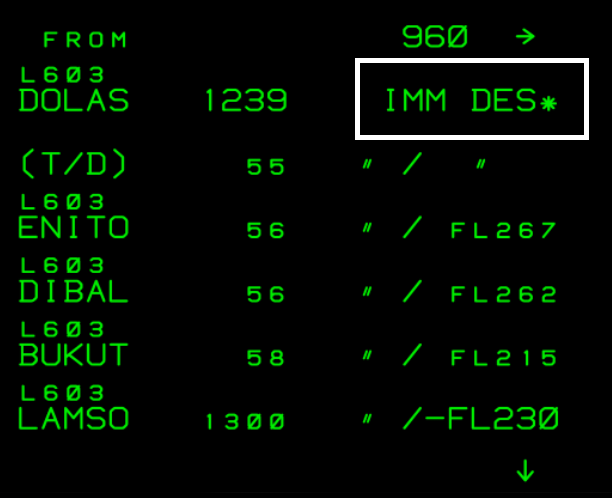
If, due to ATC instructions or for passenger comfort, a descent is to begin prior to reaching the T/D point, this can be achieved via the use of the IMM DES (Immediate Descent) mode. This mode becomes available on the FMS F-PLN A page whenever DES is armed. IMM DES allows for PROF mode descents to begin earlier, and at a rate that may be shallower or steeping that the ideal vertical profile. Some pilots in the real aircraft use this feature to begin a shallow descent prior to reaching the T/D point, allowing for a smoother transition to the ideal vertical profile.
The process for using IMM DES mode is:
- With the T/D point ahead of the aircraft, reduce the ALTITUDE on the FMP to the next cleared descent altitude.
- Pull the ALTITUDE knob to arm DES mode.
- On the FMS F-PLN A page, the IMM DES mode will now be available for selection in the top right field.
- When approximately 5nm from the T/D point, press LSK1L to activate IMM DES.
- The aircraft will immediately begin descending at the IMM DES default of -1,000ft/min. This value can be edited by the pilot by copying a new value from the scratchpad.
- If the vertical speed provided by IMM DES is less than the vertical speed required to maintain the ideal vertical profile, there will be a point where the aircraft will intercept the ideal vertical profile. This Intercept Point is labelled as (I/P) on the FMS and ND.
- When the aircraft reaches the I/P, it will automatically recapture the ideal vertical profile. IMM DES will no longer be available.
If the aircraft overflies the T/D point without initiating descent, or if it ends up significantly higher than the ideal vertical profile during descent, DECEL (deceleration) becomes available on the F-PLN A page. When active, DECEL mode reduces the AFCAS target speed to green dot speed, slowing the aircraft and allowing for a steep descent to recapture the ideal vertical profile.
The process for using DECEL mode is:
- With the aircraft above the ideal vertical profile, reduce the ALTITUDE on the FMP to the next cleared descent altitude.
- Pull the ALTITUDE knob to arm DES mode.
- On the FMS F-PLN A page, the DECEL mode will now be available for selection in the top right field.
- Press LSK1L to activate DECEL.
- The aircraft will immediately begin slowing to green dot speed, and it will attempt to descend at a rate that will allow it to recapture the ideal vertical profile. The point at which the aircraft will recapture the vertical profile is labelled as I/P on the FMS and ND.
- When the aircraft reaches the I/P, it will automatically recapture the ideal vertical profile. DECEL will no longer be available.
Descents can also be performed using other basic AFCAS modes, either from the T/D or via pilot intervention during descent:
- LVLCH: The AFCAS will command LL (Low Level) thrust and will vary pitch to maintain the target speed during descent. The AFCAS will automatically level off the aircraft at the altitude selected on the FMP.
- V/S: The AFCAS will pitch the aircraft down to the vertical speed selected on the FMP. ATS will adjust throttles to attempt to maintain the selected speed. The use of the speedbrakes may be required at high vertical speeds. The AFCAS will automatically level off the aircraft at the altitude selected on the FMP.